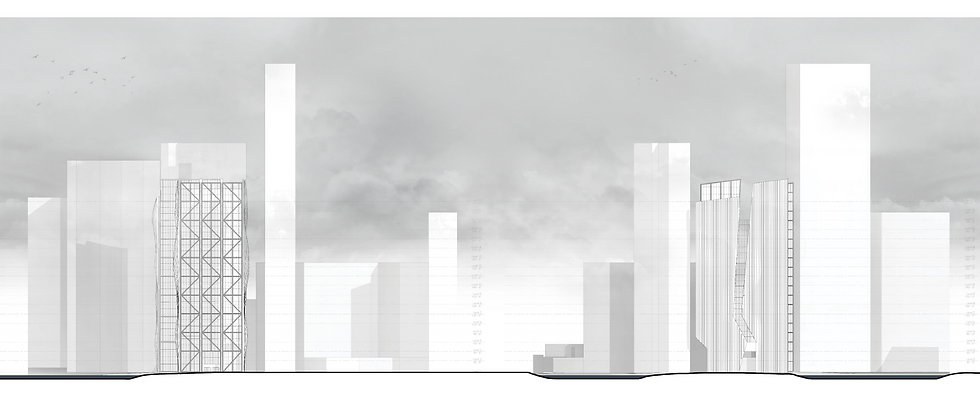
Culinary & Urban Agricultural Research Center
41°53'15.7"N 87°38'15.7"W
Chicago, IL 60654 – United States
Project Type: Education Center
Focus: Research Center
Extension to the University of Chicago

PROJECT STATEMENT
A strategically designed counterpart to aid in the fight against environmental challenges, and its impact on the accessibility of food in densely populated areas such as Chicago. The intent behind the design of this building is twofold. Partly by giving individuals the opportunity to seek higher education in their craft, while simultaneously bringing awareness to conservation. The basis of the conversation is to remain the same; the way in which people are gathered by the undeniable influence of food. A shift will occur when technologies used to obtain said food are changed. The need for a building type such as this isn’t so that it is one of a kind -it is designed with hope and intent that it will change how buildings are used, programmed and evaluated. It is in hope to inspire a new norm of what architecture should represent.
Proposed Building Construction & Materials
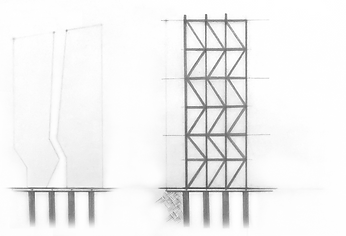
Diagonally Braced, Vertical Steel Truss System – Exterior Framing
High strength-to-weight ratio: Makes for a stronger product, and structure that can withstand heavy wind and snow loads
Intumescent Coating: Easy application, highly durable, and an eco-friendly alternative for numerous applications
Eco-friendly: Steel trusses are fabricated using up to 90% recycled content and are also 100% recyclable at the end of their lifespan
Deep Foundation: Caisson w/ Concrete Pedestal
Pile Cap: High axial and lateral loading capacity
Conceptual exploration of facade design.
BUILDING TYPOLOGY
Education Center: Gastronomy
The Education Center’s purpose is to grasp a better understanding of taste, and creativity, as well as to obtain a deeper appreciation for cooking techniques. Gastronomy is a comprehensive study of food and culture that is derived from a multitude of perspectives. When this is understood, it can be translated into conversation, and bring people together.
Research Center: Vertical Farm
The Research Center’s purpose is to redefine the traditional supply and demand of produce. As humanity grows, large cities such as Chicago grow more densely populated. Vertical farms such as this one will be able to produce more crops, while maintaining a “small” footprint. As of now, the city’s markets don’t meet the demand of their consumers; the goal for this farming technique is to grow fresh, high quality produce for said consumers.

Chicago, IL 2020
Give local eateries, and cafes a chance to be a part of the conversation of locally sourced produce

Existing amount of markets don't meet the demand
Important to expand and provide the option of supplying quality produce

Hands on learning - students can experience and learn the complete process of growing produce, in hopes of inspiring new cooking methods & techniques

CONSIDERATIONS
Vertical Farming
Year-long crop production, minimal water usage compared to traditional farming methods, immediate resource, eliminates agricultural run-off, assists in the reduction of use of fossil fuels, creation of a sustainably urban center for the community, creates opportunity for awareness
Grey Water
Conservation of fresh water, reduces overall water waste, minimizes energy and chemical consumption, reduce and reuse for irrigation/landscaping
Bioswale
The linear, vegetated ditches allows for the collection, conveyance, filtration and infiltration of stormwater while serving a pleasing and aesthetic quality, the replacement of traditional concrete gutter with an earthen one, where the vegetation reduces the water's velocity allowing for treatment and infiltration, flexible application
Deep-water Source Cooling
An alternate-energy system that uses cold water from the locally sourced deep water, to cool a building, energy savings between 70-90% (important for building type that relies heavily on artificial lighting for plantings), short economic payback period, environmentally conscious cooling solution, no evaporative water consumption
Environmentally Conscious Steel Structure
Responsibly sourced, fossil free operations by 2045, advanced high strength steel products at lower weight aids in the reduction of overall environmental footprint


FAÇADE EVOLUTION
SITE PLAN

N

INTERIOR RENDER
SECTION PERSPECTIVES


EAST ELEVATION
SOUTH ELEVATION